What your readers can do with it
A conversion on its own is easy to get wrong and hard to check. The unit converter shows the conversion factor it used and the same value in every unit of that quantity, so a reader can see at a glance whether 32 psi really is about 220 kPa.
- 19 quantities: length, area, volume, mass, time, speed, acceleration, force, pressure, energy, power, torque, temperature, angle, frequency, data, density, flow and electric charge.
- A free-form box for compound units and sums:
9.81 m/s^2 to ft/s^2,5 ft + 3 in to cm,2 kWh to MJ. - Expressions in the value box, such as 3/4 or 2^10, and exact definitions for gallons, tons, calories and mmHg.
Where it fits
An automotive blog can put it under a tyre pressure or torque spec table, where readers switch between psi and bar or N·m and lbf·ft. A lab manual can embed it beside a procedure written in one unit system for students used to the other. HVAC, hydraulics and process engineering pages get the most from the flow, pressure and power categories.
Suggested size
The default frame is 1,040 px high and up to 960 px wide, enough for the inputs, the result and the full list of units for a quantity such as pressure. The free-form box sits at the bottom of the tool, just inside the default height, so do not make the frame shorter if your page is about compound conversions. On a phone the tool is about 1,210 px tall.
What it opens on
The widget opens on pressure, converting 1 psi to kilopascals: 6.894757293 kPa, with pascals, bar, millibar, ksi and the rest listed underneath. It does not read a conversion from its address yet, so a link cannot open it on, say, torque. Tell readers what to choose beside the frame instead: "Pick Torque, type 250 and convert N·m to lbf·ft." The result, about 184.4 lbf·ft, appears as they type.
Two notes worth passing on: write powers with ^ and division with /, and write temperatures as degC, degF, K and degR in the free-form box.
Add it in three steps
- Press Copy embed code above.
- Paste the code into an HTML block next to your spec table or procedure.
- Name the quantity and units readers should pick, so they get the right list on the first try.
Frequently asked questions
Can readers convert compound units like mi/h or m/s²?
Yes. The free-form box at the bottom takes a whole conversion, such as 60 mi/h to m/s, which gives 26.8224 m/s.
Does it show the conversion factor?
Yes. Every result shows the factor used, so readers can copy it into their own working or a spreadsheet.
Can I make it open on a different quantity?
Not yet. It always opens on pressure. Tell readers which quantity to pick; the menu is the first box in the tool.
More calculator widgets
Want the explanations and worked examples as well? They are on the full Unit Converter page. All 24 widgets, each with a Copy code button, are in the calculator widget gallery.
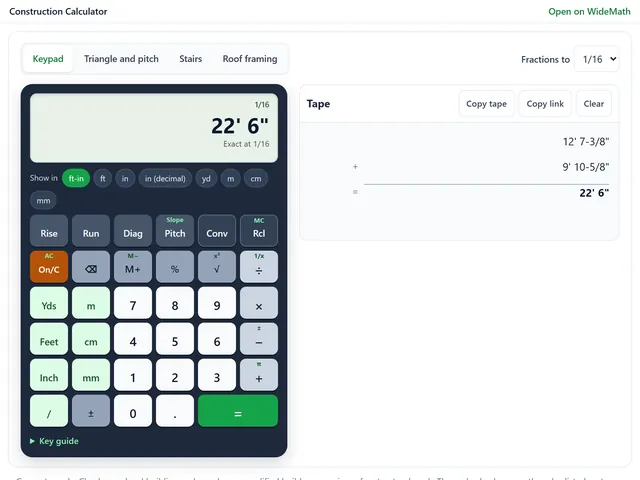
Construction Calculator
Feet, inches and fractions on a Construction Master style keypad, plus stairs and rafters.
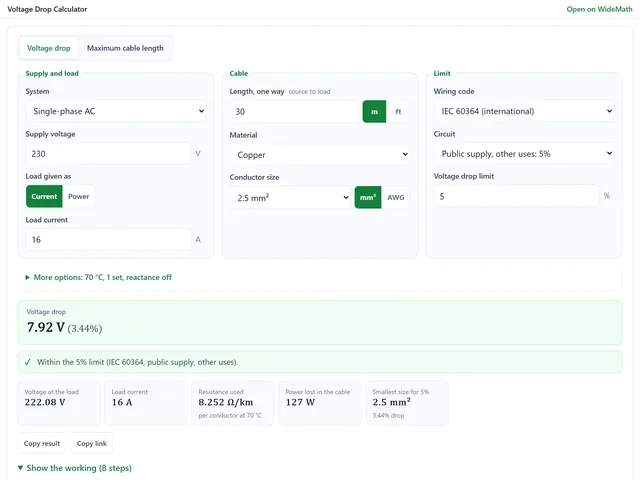
Voltage Drop Calculator
Voltage drop in AWG or mm² against NEC, BS 7671, IEC or AS/NZS limits, with the smallest size.
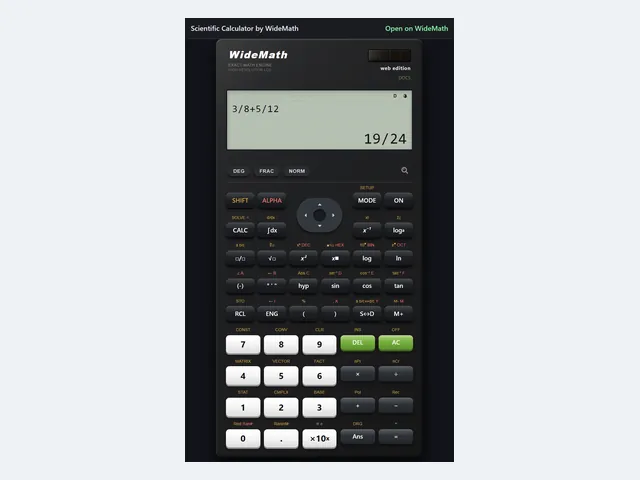
Scientific Calculator
A Casio-style keypad with exact fractions and eight modes, narrow enough for a sidebar.