What your readers can do with it
Complex numbers turn up in two very different classrooms. Maths students meet them as a + bi, polar form and De Moivre's theorem. Electrical students meet them as phasors and impedances written with j and an angle. The complex number calculator speaks both languages:
- type
3 + 4i,3 + j4,5∠53.13or5e^(0.9273i), and read the answer in rectangular, polar (degrees and radians) and exponential form at once; - conjugate, modulus, argument, powers and all n roots, with the working and an Argand diagram;
Z1 || Z2for two impedances in parallel;- a Phasors and AC circuits tab: frequency, source voltage, then resistors, inductors and capacitors in series or parallel.
Where it fits
On a circuits course page, embed it beside an RLC example so students change one component and watch the power factor move. On a maths page about the argument of a complex number, it shows why arctan(b/a) alone gets the quadrant wrong: the working adds or subtracts 180° and says why.
Suggested size
The default frame is 1,180 px high and up to 960 px wide, which fits the first tab with its results, working and diagram. The AC circuit tab is longer, about 2,030 px with three components at that width, so for a circuits page set the height to about 1,400 px and let the rest scroll inside the frame. On a phone the first tab is about 1,890 px tall.
Open it on an RLC circuit
This link opens the AC tab with a 230 V, 50 Hz source driving a 40 Ω resistor, a 200 mH inductor and a 100 µF capacitor in series:
https://widemath.com/embed/complex-number-calculator/?tab=ac&f=50&v=230&va=0&conn=series&p=R40,L200mH,C100uF
The widget gives a total impedance of 40 + j31.000864 Ω, or 50.606853∠37.776458° Ω, a current of 4.544839 A lagging by 37.78°, a real power of 826.22 W and a power factor of 0.790 lagging. It also reports the LC resonance at 35.59 Hz. For the first tab, ?z= takes an expression, such as ?z=root(8i,3) for the three cube roots of 8i.
Add it in three steps
- Load the circuit if you want it, raise the height for the AC tab, and press Copy embed code.
- Paste the code into an HTML block on your course or blog page.
- Ask one question under it, such as "Which component would you change to bring the power factor to 1?"
Frequently asked questions
Can readers type j instead of i?
Yes. Both work, and when a reader types j the answers are written with j too, which is what electrical students expect.
Does it handle phasors with an angle?
Yes. Use the ∠ symbol or the less-than sign, as in 10∠30 + 5∠-45. The Degrees and Radians switch sets the unit of every angle typed and shown.
What does the AC tab assume?
Ideal components in sinusoidal steady state. The source can be given as RMS or peak, and the frequency in Hz or rad/s.
More calculator widgets
Want the explanations and worked examples as well? They are on the full Complex Number Calculator page. All 24 widgets, each with a Copy code button, are in the calculator widget gallery.
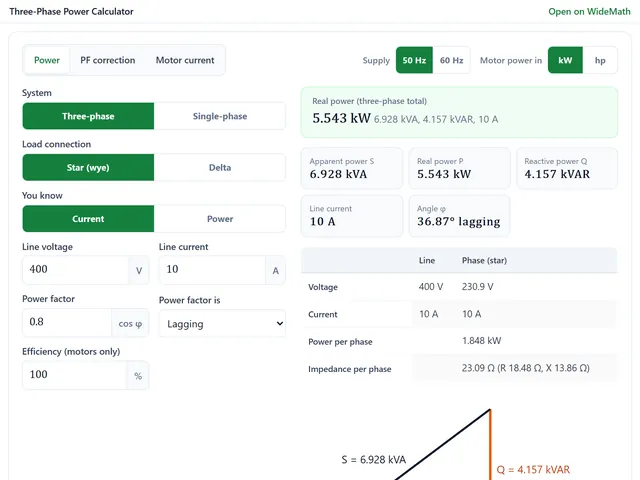
Three-Phase Power Calculator
kW, kVA, kVAR and current for star or delta, capacitor bank sizing and a resonance check.
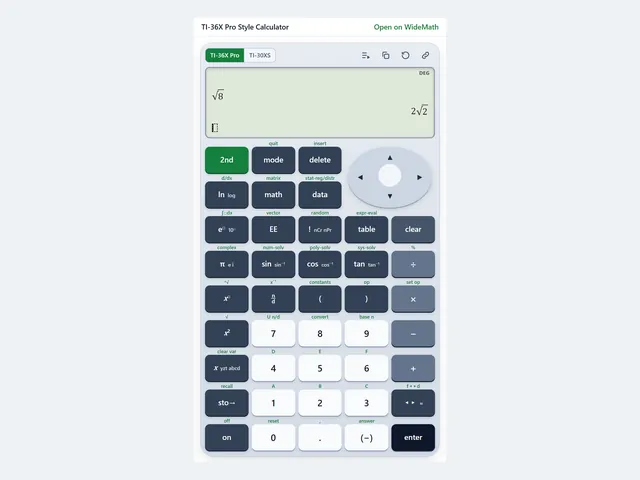
TI-36X Pro Style Calculator
FE exam keystrokes on a TI-36X Pro style keypad, with a TI-30XS MultiView switch.
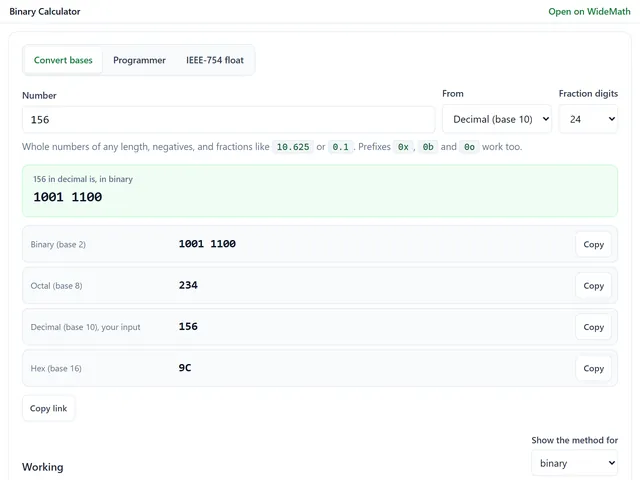
Binary Calculator
Base conversion with working, two's complement, bitwise operations and IEEE 754 floats.