What your readers can do with it
A lab protocol says "make 250 mL of 0.5 M NaCl" and leaves the arithmetic to the person at the bench. The molarity calculator does that arithmetic and says what to do with the answer: weigh 7.305 g, dissolve it in about 200 mL of water, then make up to 250 mL in a volumetric flask. Its five tabs cover most of a prep room's maths:
- Molarity: a formula (NaCl, CuSO4·5H2O) or a name (Tris, disodium EDTA), with the molar mass split element by element. Solve for mass, volume, concentration or molar mass.
- Dilution: C₁V₁ = C₂V₂ with different units on each side, and 10x or 50x stocks as they are.
- Serial: a dilution series from a start concentration, a factor and a number of tubes.
- Recipe: several reagents at once, with a printable prep sheet.
- Buffer: a buffer at a target pH, concentration and temperature, by mixing two forms or titrating one.
Where it fits
Put it inside a lab manual next to each solution a practical needs, so students work out their own masses before the session. A core facility can embed it on its protocols page, and a chemistry teacher can use the Molarity tab to show where the molar mass comes from, atom by atom.
Suggested size
The default frame is 1,060 px high and up to 960 px wide, which fits the Molarity tab with its result, its summary cards and the molar mass table. The Recipe and Buffer tabs can grow with the number of reagents, so add 200 to 300 px if your page uses them. On a phone the Molarity tab is about 1,520 px tall and scrolls inside the frame.
Open it on a buffer dilution
Each tab keeps its inputs in the address. This link opens the Dilution tab for making 500 mL of 1x TAE from a 50x stock:
https://widemath.com/embed/molarity-calculator/?tab=dilution&c1=50x&c2=1x&v2=500mL
The widget answers: take 10 mL of the 50x stock and add 490 mL of water or buffer, a 1:50 dilution. A link to the Molarity tab only needs the formula and two values, such as ?formula=NaCl&c=0.5M&v=250mL.
Add it in three steps
- Load the dilution or keep the NaCl example, then press Copy embed code.
- Paste it into your lab manual or course page as HTML, next to the solution it is for.
- Remind students to check the formula on their own bottle, since a hydrate changes the mass to weigh.
Frequently asked questions
Does it know the molar mass of hydrates?
Yes. Type the hydrate as it appears on the label, for example CuSO4·5H2O, CuSO4.5H2O or CuSO4*5H2O, and the water of crystallisation is included: 249.68 g/mol for copper sulfate pentahydrate.
Can it plan a serial dilution?
Yes. The Serial tab takes the starting concentration, the dilution factor, the number of tubes and the volume per tube or per transfer, and lists every tube.
Will the buffer come out at exactly the right pH?
It is a planning figure. Finish every pH adjustment on a calibrated meter, as the note at the bottom of the widget says.
More calculator widgets
Want the explanations and worked examples as well? They are on the full Molarity Calculator page. All 24 widgets, each with a Copy code button, are in the calculator widget gallery.
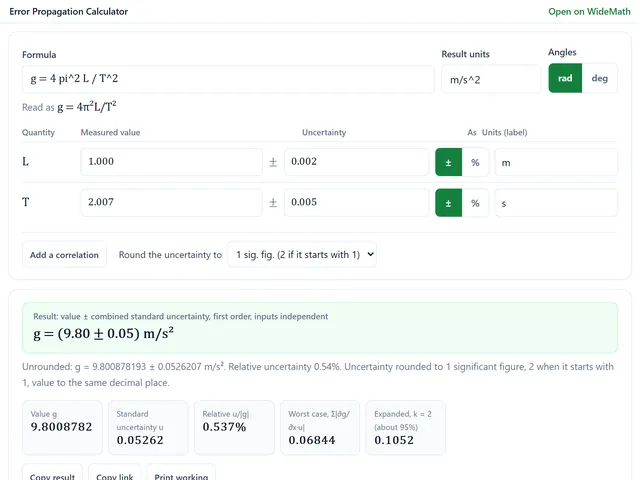
Error Propagation Calculator
Uncertainty of any formula, with the partial derivatives, each input's share and a Monte Carlo check.
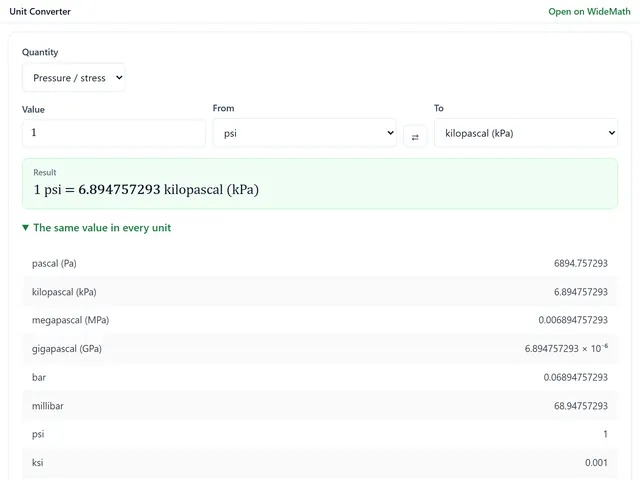
Unit Converter
19 engineering quantities, every unit at once, and a free-form box for compound units.
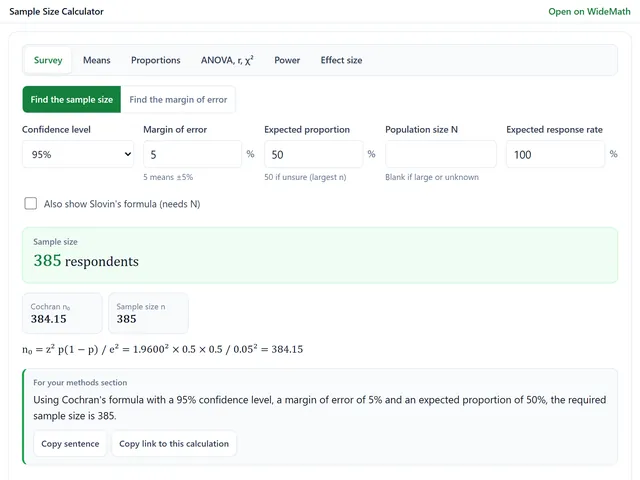
Sample Size Calculator
Survey sample sizes and power analysis for t-tests, ANOVA, proportions and chi-square.