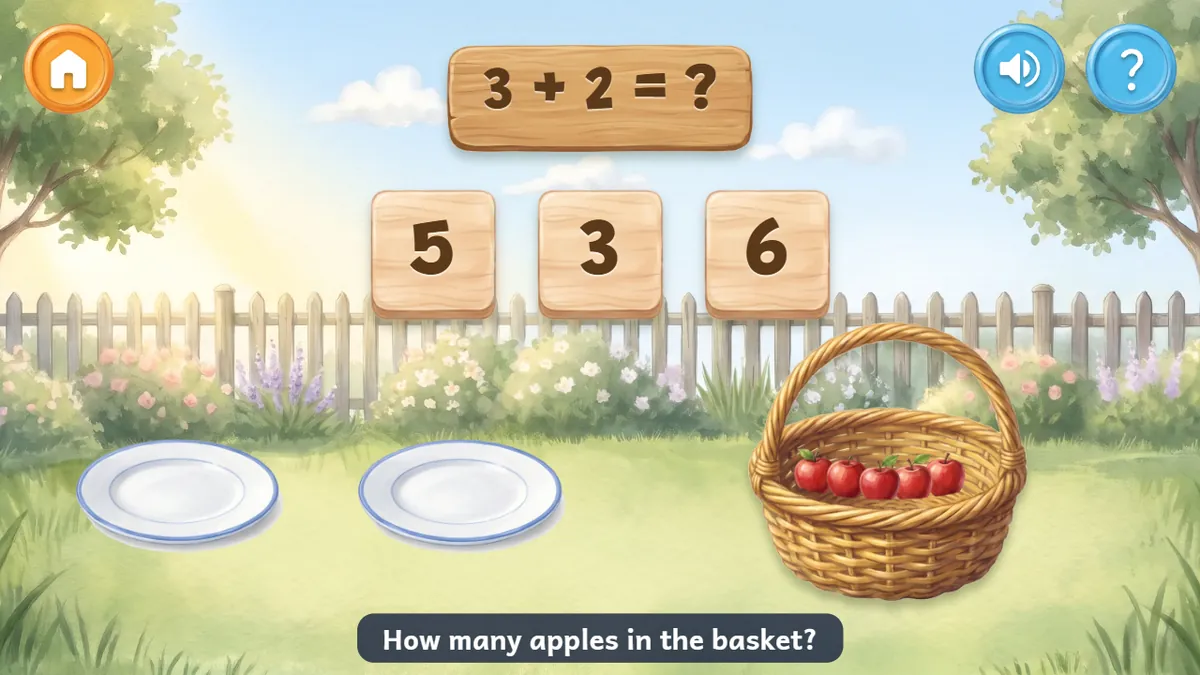
Keep the objects beside the written sum so your child can point to what each number means. Try this together for a short maths turn tonight.
Addition can join two amounts to find how many there are altogether.
What your child does in the game
Your child moves every apple from two plates into a basket while the voice counts. They then tap the total on one of three number buttons. The adding game uses totals up to 10. Try adding with totals up to five
How do I teach addition to a 4 or 5 year old?
Start by joining two small groups of objects where your child can see them.
Try two blocks and one more. Count the first group, name the extra block, then bring them together. Ask, "How many altogether?" Count the whole collection together if you want to check. Afterwards, write 2 + 1 = 3 beside it. The plus sign joins amounts; the equals sign says both sides have the same value.
Change one amount on the next turn. You might use two and two, then two and three, rather than introduce a new story and new objects at the same time.
Is counting on fingers bad?
Your child can use fingers for early addition; Common Core K.OA.A.1 includes them.
Hold up two fingers on one hand and three on the other. Count all five, then show the same sum with blocks. Let your child keep using their hands. You can leave the blocks out too, so they can check the total.
How do I explain counting on?
Counting on means keeping the first amount and counting only the objects you add.
For 4 + 2, say "Four" while pointing to the first group. Move the two new blocks one at a time: "Five, six." Those two spoken steps match the two additions. If your child wants to count all six afterwards, leave the blocks in view.
How do I teach making 10 and doubles?
Show your child the two parts that make ten, and make two equal groups for doubles.
Draw a tens frame: two rows of five spaces. Put seven blocks in it, count the three empty spaces, then fill them. Say, "Seven and three make ten." For doubles, make two matching rows of three and say, "Three and three make six." Keep the whole in view. Our teaching order places making and splitting amounts before formal written work.
Common mistakes and what to do
Watch which objects your child counts, then use the matching example below to show the sum again.
| What you see | What it means | What to try |
|---|---|---|
| Your child answers three for two plus three | Three names only the second group | Push both groups onto one mat, then count the whole collection |
| A block gets counted twice | The count includes the same item again | Move each counted block into a finished row |
| For 4 + 2, your child says "four, five" and answers five | The starting amount was counted as an added step | Say "Four already"; move one new block for "five" and one for "six" |
| Your child counts all the blocks every time | The method is counting all | Let the count finish; offer counting on once with the first group kept together |
| Your child says seven and two make ten | Nine spaces are filled; one is still empty | Use ten drawn spaces and fill each empty space with one block |
| Your child calls three and four a double | The parts differ by one | Match the rows in pairs; point to the extra block before making both rows equal |
Try it without a screen in 2 minutes
You only need five blocks and two small plates.
- Put two blocks on one plate and three on the other.
- Name each amount, then slide all the blocks together.
- Count once, moving each block as you say its number.
- Say, "Two and three make five." Split them again and invite another turn.
Practise in the game
Add to five joins small groups with totals from two to five.
Add to ten joins larger groups with totals no greater than ten.
Make ten uses 9+1, 8+2, 7+3, 6+4 and 5+5.
Doubles to ten joins equal amounts from 1+1 through 5+5.
What schools expect
Schools include work with objects, number bonds and facts to recall, as shown below.
| US Common Core (2010) | England EYFS (September 2026) and DfE guidance (2020) |
|---|---|
| K.OA.A.2 covers object-based addition and subtraction within 10. K.OA.A.5 says, "Fluently add and subtract within 5." | ELG: Number includes bonds to 5, some bonds to 10 and doubles. Year 1 1NF-1 says, "Develop fluency in addition and subtraction facts within 10." |
These expectations include more than joining apples in the game. For the wider sequence, use the US and England teaching guide.
Sources
- Common Core kindergarten operations (2010), K.OA.A.1 to A.5.
- Common Core Grade 1 operations (2010), counting on and equation meaning.
- EYFS statutory framework, September 2026, Number, page 15; tens frames, page 11.
- DfE Mathematics guidance: Year 1 (2020), 1NF-1, pages 17 to 18.
Questions parents ask
How do I teach addition to a 5 year old?
Join two small groups of blocks and count them together. Try two and one first, then two and two. Ask, "How many altogether?" Write a sum beside the blocks afterwards if you wish. Point to each group as you read it, so your child can see what every number means.
Is counting on fingers bad?
Let your child use their fingers: Common Core K.OA.A.1 includes fingers as a way to show addition. Hold up two fingers and three more, then count five altogether. Make the same groups with blocks and compare them. Leave both ways available while you talk through the sum.
How do I explain addition?
Tell a story about putting amounts together: two blocks here and three there make five altogether. Move both groups together as you say it, then count all five. Read 2 + 3 = 5 beside the blocks, pointing to each amount. Leave them there for your child to check.
How do I teach doubles?
Make two equal rows and count the total: three blocks and three blocks make six. EYFS Number includes double facts among some bonds to 10. Match each block in one row with one in the other, then name the whole. The game's doubles set ends at 5+5.