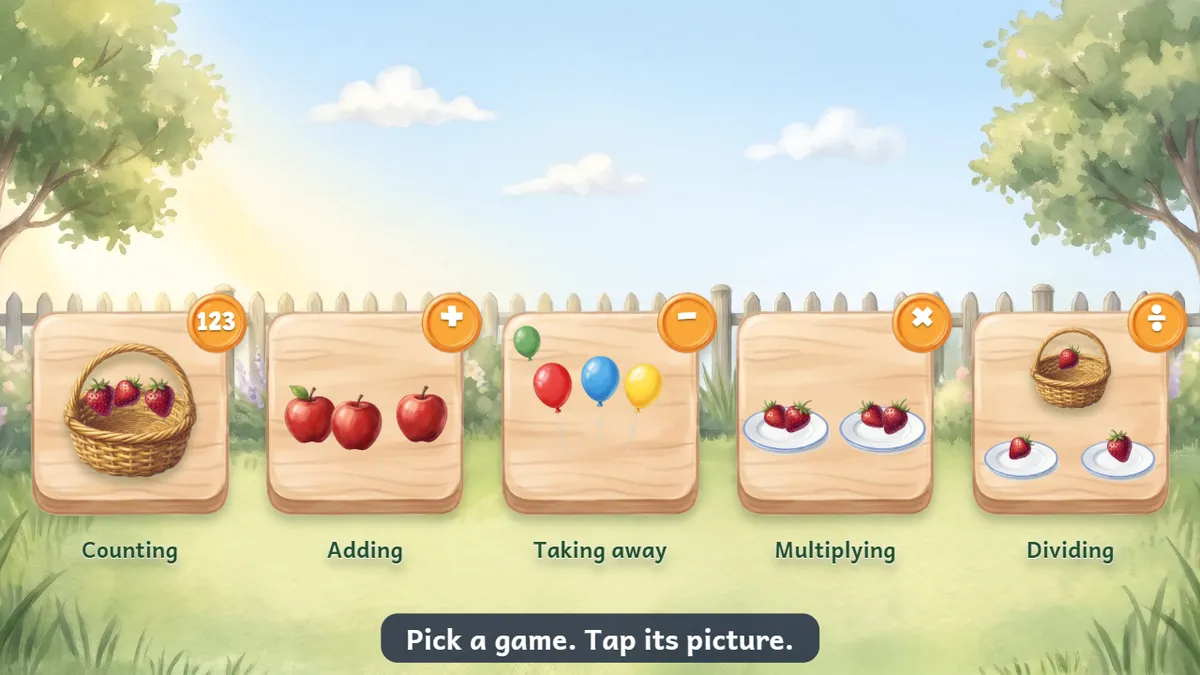
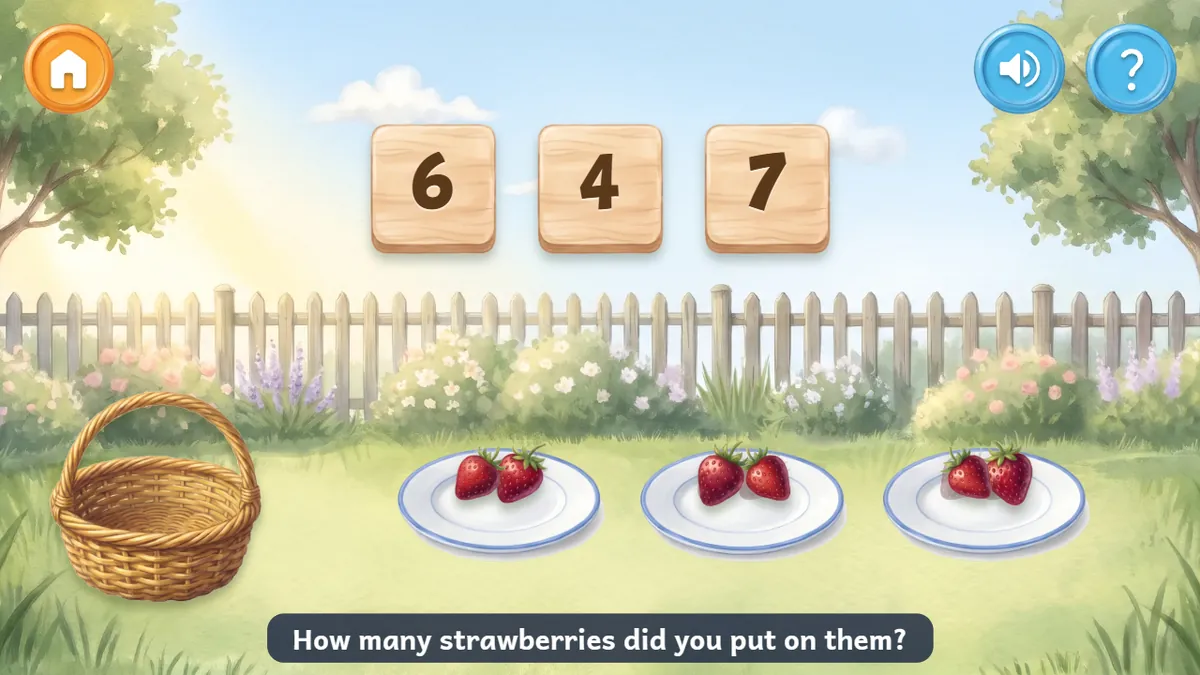
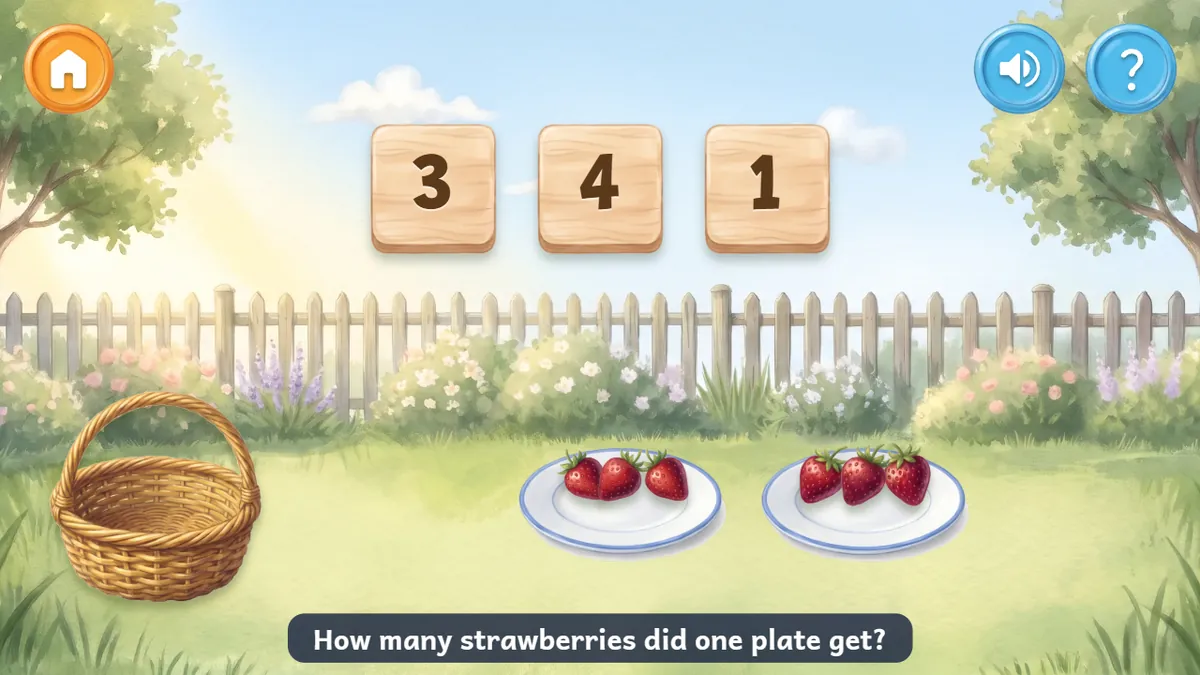
A voice reads every question, with captions too. Choose counting, adding, taking away, multiplying or dividing, or type your own questions for a custom game.
How do we start playing?
Tap the big Play button, then choose one of five picture tiles in the garden.
Open the garden games in the browser on a phone, tablet or computer, with nothing to install. Turn sound on. On a phone, turn it sideways when the game asks. A hand shows each new move once; the Help button uses the hand and voice to show the method on the question.
What are the five games?
Each game turns one number action into something your child can move or tap.
| Game | What the child does | What it practises | Play |
|---|---|---|---|
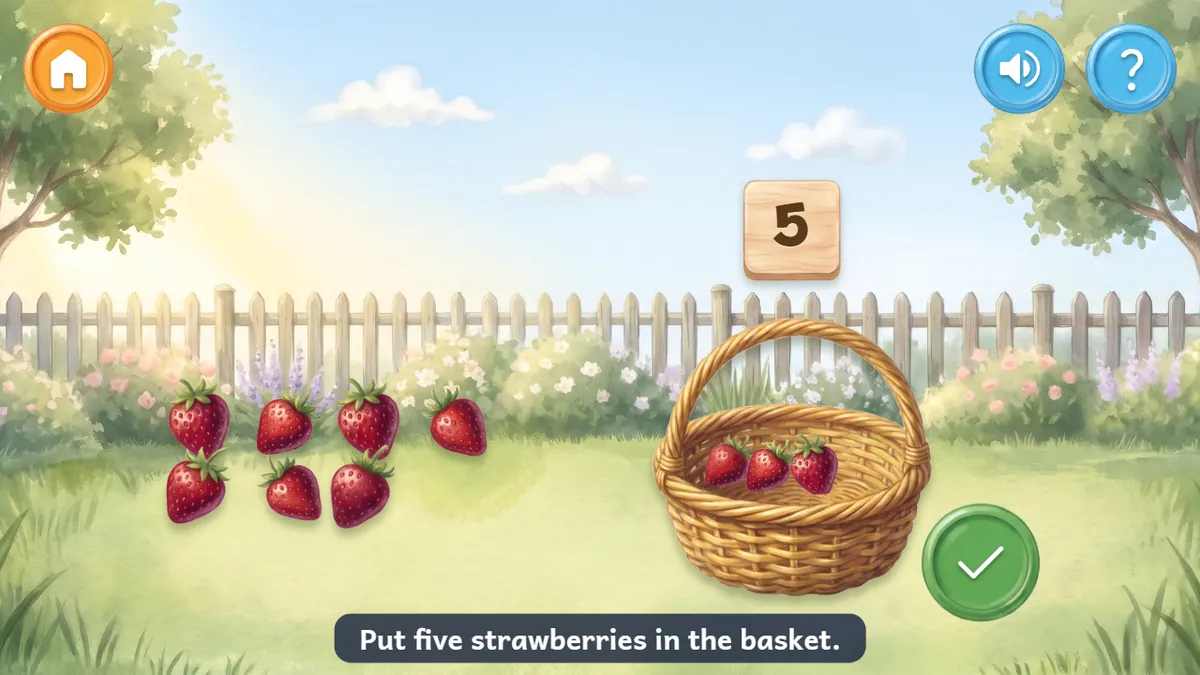
| Counting | Drags strawberries into a basket and taps the green tick | Counting out 1 to 10 objects | Count to five |
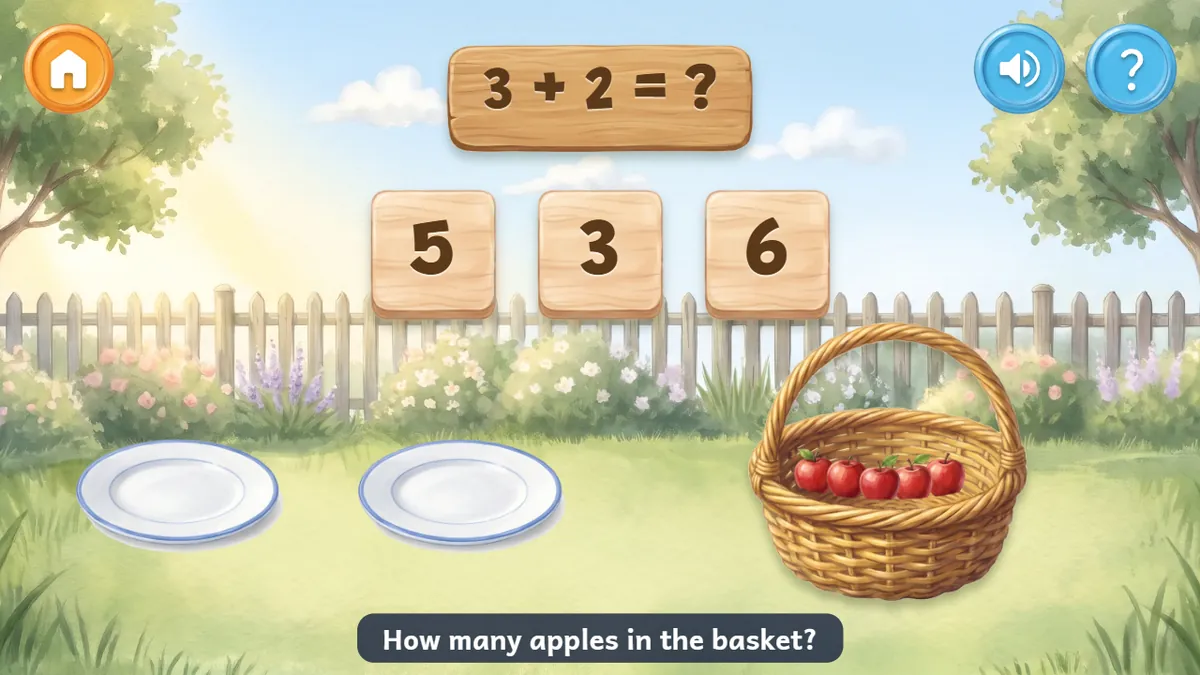
| Adding | Moves apples from two plates into a basket and taps the total | Joining amounts with totals up to 10 | Add to five |
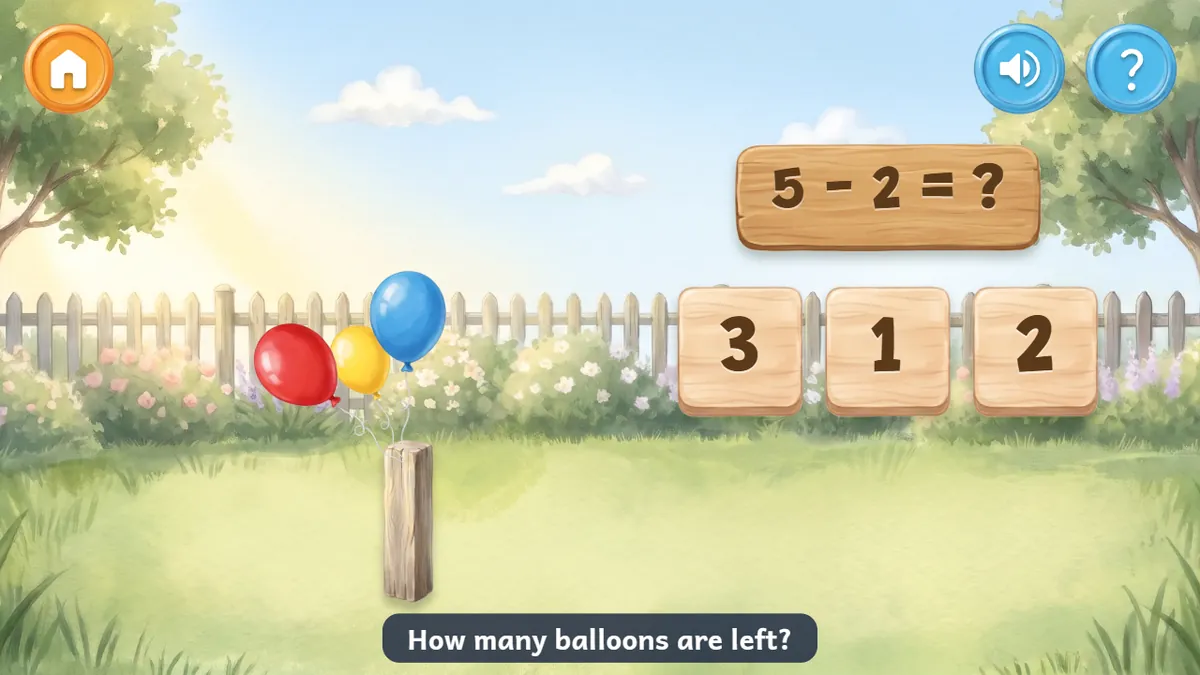
| Taking away | Taps balloons to send them away, then taps how many remain | Starting with up to 10 and removing up to 5 | Take away to five |
| Multiplying | Puts the same number of strawberries on each plate | 2 to 4 equal groups with 2 to 5 in each, totals up to 20 | Groups of two |
| Dividing | Shares strawberries onto plates and taps how many each gets | Equal sharing onto 2 to 4 plates, with 1 to 5 on each | Share between two |
Can I make my own game?
Type up to 20 questions, such as 2+3, 7-2, 3x2, 6/2, 8.
Play them in order or shuffle them; each kind uses its own scene.
Make your own game and share it as a link. Questions outside this version's limits are listed for the grown-up with a reason and are not played.
Where should we begin?
Choose an action you want to try together, or use the 12-step teaching order for US and England school references.
Our method, sources and privacy note tells you who made the games and how we use the objects, voice and hand. Each of the five guides above gives you a two-minute activity to try with real objects.
What happens to progress and visit counts?
Progress stays on this device, in the browser. There are no ads and no third-party trackers on these pages. We count visits and plays anonymously, with no cookies and nothing that identifies you or your child, so we can tell whether the games are useful. The about page has the switch to stop that counting on this device.
Questions parents ask
Are these math games free?
Yes, these math games are free, with no sign-up or account and nothing to install. They run in the browser on phones, tablets and computers. Turn sound on to hear each question; every line has a caption too. On a phone, turn it sideways when the game asks.
Is there a math game where you can put in your own questions for free?
Use Make your own game to type up to 20 questions for the garden scenes. It is free, with no account. You can keep the order or shuffle, then share a link. Questions outside this version's limits are listed with a reason and are not played.
What order should I teach math skills?
Our dated 12-step guide starts with counting objects and making small amounts. It then connects adding, taking away, equal groups and division, with US and England school references beside each step. Use the ages to find your way around and ask your child's teacher where to begin.