Keep the blocks you moved away in a separate bowl. Point to the plate as you ask about what is left, so your child can check the answer.
Taking away finds what is left after removing an amount; subtraction can also compare two amounts.
What your child does in the game
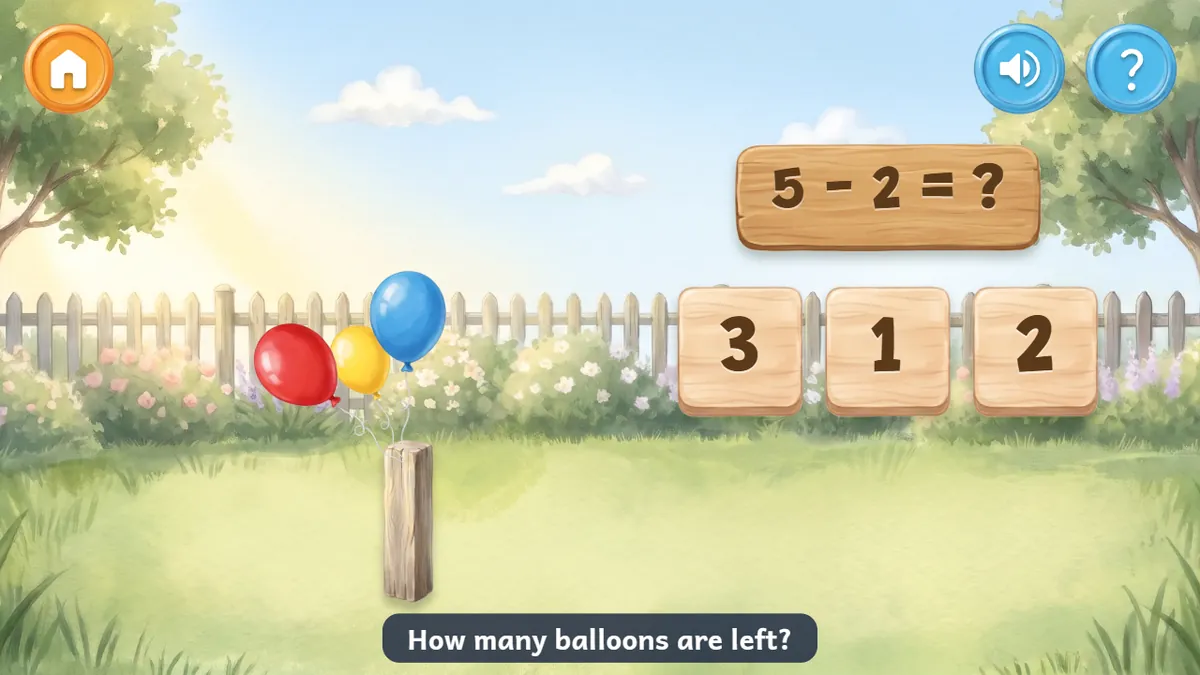
Your child taps balloons on a post and they fly away. The starting number is up to 10, and the amount taken away is up to 5. Your child then taps how many balloons are left. Try taking away from numbers up to five
How do I explain subtraction to a 5 year old?
Act out a small taking-away story and count only the objects that are left.
Put five blocks on a plate. Ask your child to move two to a separate bowl. Point to the plate: "How many are left here?" Count three together. Write 5 - 2 = 3 beside the plate, then retell what each number means. If you repeat the story, put all five back before starting.
How do I teach counting back?
Count back one step for each object you take away.
For 5 - 2, say "Five to start." Move the first block away and say "Four left." Move the second and say "Three left." You made two removals, so there are two steps. Saying "five, four" while removing two blocks counts the starting number as a step.
You can also draw a number track with boxes labelled 0 to 5. Start on 5 and move back two boxes, landing on 3. Keep the blocks nearby to check what each move represents.
Why does "find the difference" confuse children?
"Find the difference" asks your child to compare two amounts. Common Core 1.OA.A.1 includes both taking away and comparing.
Put one row of five blocks beside a row of three. Match them in pairs. Two blocks in the longer row have no partner, so the difference is two. All the blocks stay where they are. Ask, "How many more does this row have?" Then show 5 - 3 = 2 beside the rows.
The balloon game shows taking away. Try a comparison with real blocks as a separate turn rather than expect the balloon scene to show both meanings.
Common mistakes and what to do
Check whether your child counted the blocks you took away or the blocks still on the plate, then try the matching row below.
| What you see | What it means | What to try |
|---|---|---|
| Your child answers two for five take away two | Two names the removed amount | Leave the removed blocks in a bowl; point to the plate and count what is still there |
| Your child recounts all five, including the removed blocks | The count includes both locations | Move the bowl farther aside and circle the plate with your finger |
| Your child says "five, four" and answers four for 5 - 2 | Only one backward change has been named | Say "Five already"; name four after the first removal and three after the second |
| A second turn starts with the three remaining blocks | The starting amount has changed | Rebuild five before retelling five take away two |
| Your child takes three from the row of three in a comparison | The action follows a taking-away story | Keep both rows intact; pair blocks and count only the unmatched extras |
Try it without a screen in 2 minutes
You only need five blocks, a plate and a bowl.
- Count five blocks onto the plate.
- Say, "Two go into the bowl," and move exactly two.
- Ask, "How many are left on the plate?" Count together if needed.
- Say the complete story, then return all five before another turn.
Practise in the game
Take away to five uses starting amounts from two to five.
Take away to ten uses starting amounts from six to ten, removing no more than five.
What schools expect
Schools include taking away, related number facts and work with objects, as shown below.
| US Common Core (2010) | England national curriculum (2013) and DfE guidance (2020) |
|---|---|
| K.OA.A.2 covers addition and subtraction within 10 using objects or drawings. K.OA.A.5 says, "Fluently add and subtract within 5." | Year 1 addition and subtraction includes "number bonds and related subtraction facts within 20". 1NF-1 says, "Develop fluency in addition and subtraction facts within 10." |
The game offers taking-away questions within its smaller limits. See the teaching order for the wider curriculum context.
Sources
- Common Core kindergarten operations (2010), K.OA.A.1, A.2 and A.5.
- Common Core Grade 1 operations (2010), 1.OA.A.1 and C.5.
- England mathematics programmes of study (2013), Year 1 addition and subtraction.
- DfE Mathematics guidance: Year 1 (2020), 1NF-1 and 1AS-2.
Questions parents ask
How do I explain subtraction to a 5 year old?
Show five blocks, remove two and count the three still on the plate. Common Core K.OA.A.1 includes acting out subtraction with objects. Keep the removed blocks separate and say the whole story afterwards. Write 5 - 2 = 3 beside the objects if you want to connect the action to symbols.
How do I teach subtraction with objects?
Choose a small group and a separate place for the objects you take away. With four blocks, move one into a bowl, then count the three left. Point to them and say, "Three left." Put the removed block back before another turn so you start with four again.
How do I teach counting back?
Name the starting amount before you remove anything, then say the new amount after each removal. For five take away two: "Five to start. Four left. Three left." Common Core 1.OA.C.5 relates counting to subtraction. Use the blocks to check that two removals produced two backward steps.
Why does "find the difference" confuse children?
A comparison asks how many extra objects one group has; taking away describes removing some. Common Core 1.OA.A.1 includes both. Put rows of five and three side by side, pair their blocks and count the two extras. Ask, "How many more?" Keep both rows in place as you talk.