Extend to ten, then explore eleven to twenty with real objects. The garden counting game stops at ten, so use spoons or blocks for the larger amounts.
Counting a collection pairs one number word with each object; the last word tells you how many there are altogether.
What your child does in the game
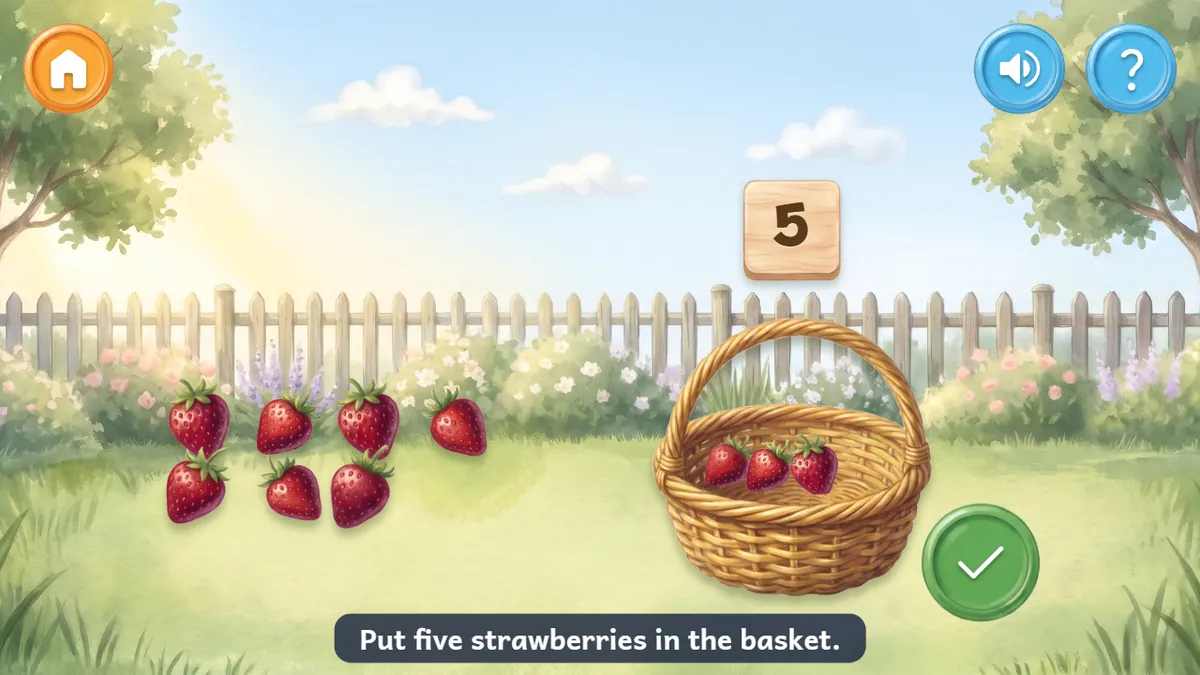
The voice asks for a number of strawberries, such as "Put 7 strawberries in the basket." Your child drags them in and taps the green tick. If there are too many or too few, the strawberries line up so your child can count again. The counting game covers 1 to 10. Try counting out numbers up to five
How do I teach counting to 10?
Count a small group together, moving each object once as you say its number.
Put five spoons beside a bowl. Ask for three, leaving the extras nearby. Move one spoon per word: "One, two, three." Stop, circle the bowl with your hand and say, "Three spoons altogether." Invite your child to choose another amount. Try larger requests when you want another turn, keeping the moving-and-stopping action the same.
Why can my child count but not understand numbers?
Saying numbers in order and counting out a group are different tasks in the IES family guide.
"Count to ten" asks for words in order. "Give Bear four spoons" asks your child to make a group and stop at four. Try both and notice what your child does. If they give a handful, count out four together and leave the other spoons aside. Try again another time to see more of how they count.
Why does the last number counted say how many?
If you count every object exactly once, the last number tells you how many there are altogether. Common Core K.CC.B.4 calls this cardinality.
Count four blocks, then sweep your hand around all four and say, "Four altogether." Spread them farther apart without adding or removing any. There are still four: K.CC.B.4b includes keeping the same number when the arrangement changes. Let your child count again if they want to check.
How do I teach numbers 11 to 20?
Show your child a full ten and the extra ones. Common Core 1.NBT.B.2b describes teen numbers this way.
Fill ten drawn spaces in two rows of five. Put three more blocks beside the full frame and say, "Ten and three more make thirteen." Try fourteen with the same ten and four extra ones. For twenty, fill a second frame: two complete tens. Use real objects for this part; the game's counting scene stops at ten.
Common mistakes and what to do
Watch your child's hands as well as listening to the number words, then choose a small next step from the table.
| What you see | What it means | What to try |
|---|---|---|
| Number words run ahead of the pointing | Words and objects are not paired in this count | Move one spoon, say one word, then pause before the next |
| A spoon is skipped or counted twice | The count loses track of an item | Use separate starting and finished piles; move each counted item across |
| Your child counts five, then counts again when asked how many | The total is being checked by another count | Allow it; finish by circling all five and saying "Five altogether" |
| Your child keeps adding after the requested four | The collection has passed the requested amount | Count four into a bowl together; name the total and stop your hand |
| A spread-out row is called bigger than the same row before | The layout changed, but no objects were added | Pair the old and new positions by moving the same blocks closer again |
| Thirteen is shown with only three blocks | Three shows the extra ones, without the ten | Keep a complete ten beside the extras and name both parts |
Try it without a screen in 2 minutes
You only need five spoons, a bowl and a toy.
- Ask, "Can you give Bear three spoons?" Keep all five in reach.
- Let your child move the spoons and decide when to stop.
- Count the chosen spoons together, moving each only once.
- Circle the group and say, "Three altogether." Offer a turn choosing two or four.
Practise in the game
Count to five asks for 2, 4, 1, 5 and 3 strawberries.
Count to ten asks for 6, 9, 7, 10 and 8 strawberries. Use real objects for amounts beyond ten.
What schools expect
Use these school references to see how saying numbers and counting objects fit together.
| US Common Core (2010) | England EYFS (September 2026) and national curriculum (2013) |
|---|---|
| K.CC.B.4b says, "Understand that the last number name said tells the number of objects counted." K.CC.B.5 includes counting out requested collections to 20. | ELG: Numerical Patterns includes "Verbally count beyond 20". Year 1 number and place value includes "count to and across 100". |
Schools ask children to say number words, count objects and read numerals, as the sources above explain. The game's limit of ten covers only part of that work. Our teaching order shows the next ideas.
Sources
- IES family and caregiver guide, counting and counting out collections.
- Common Core kindergarten counting (2010), K.CC.B.4 and B.5.
- Common Core Grade 1 place value (2010), 1.NBT.B.2b.
- EYFS statutory framework, September 2026, Numerical Patterns, page 15.
- England mathematics programmes of study (2013), Year 1 number and place value.
Questions parents ask
My 5 year old can't count to 20. What can we try?
Try counting a small group tonight: ask for three spoons, move them one at a time and say, "Three altogether." Keep saying number words and counting objects as separate turns. If you are worried, tell your child's teacher what happened and ask which small counting task to try next.
What is the difference between reciting numbers and counting?
Reciting gives the words in order. Counting objects also pairs one word with each item and uses the final word for the total, as the IES guide explains. Try "Count to five" and "Give me five blocks" as separate requests, leaving real blocks available for the second.
How do I teach numbers 11 to 20?
Keep a full group of ten visible and add extra ones. Common Core 1.NBT.B.2b describes eleven to nineteen as a ten and further ones. Build thirteen as ten and three, then fourteen as ten and four. Use real objects: the garden's counting questions stop at ten.
Is it normal for a 5 year old to count to 20 but not know how many objects there are?
Saying numbers in order and counting a group are separate steps in the IES guide. Ask your child for three blocks and watch what they do. This is a progress guide, not a test. If you are worried, talk to your child's teacher or doctor.