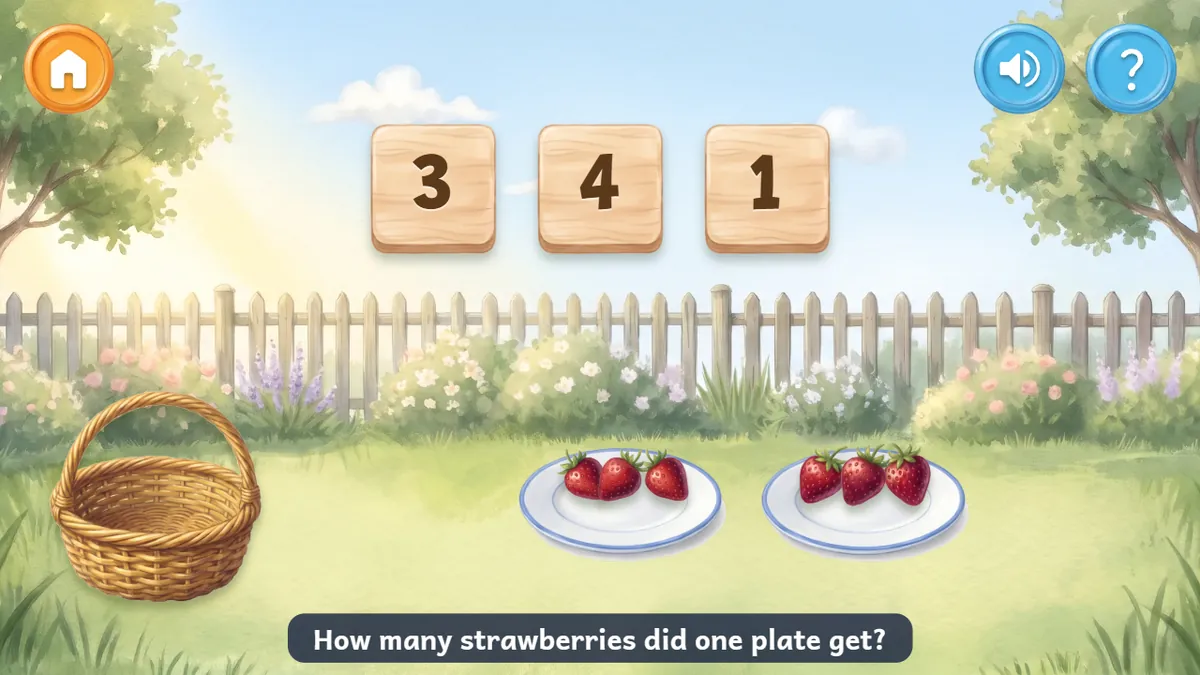
Keep both plates in front of your child as you talk about the answer. This is sharing; making groups of a set size asks a different question.
Fair sharing gives each group the same amount; division can find how much goes in each share.
What your child does in the game
Your child shares strawberries from a basket fairly onto 2 to 4 plates, one at a time. If the shares are unequal, the voice says so and your child fixes them. Your child then taps how many are on each plate, from 1 to 5. Try sharing between two plates
How do I explain division to a child?
Start with a sharing story where you know how many objects there are and how many plates need a share.
Say, "We have six blocks for two toys. Let's give them the same amount." Deal one to the first plate, one to the second, and repeat. Once the basket is empty, count the blocks on each plate. Ask, "How many does each toy get?" The answer is three, not two plates or six blocks altogether.
In the game, 6/2 means six shared onto two plates. If you write it beside real objects, read the whole story aloud. You can also revisit equal groups: two groups of three put the same six blocks back together.
What is fair sharing?
For equal-sized objects in this activity, fair sharing means every plate ends with the same number.
Do not stop at "everyone has some". Two blocks on one plate and four on another use all six, but the shares differ. Line up the blocks in matching rows and move one across. Say, "Three here, three here. The shares are equal."
What is the difference between sharing and grouping?
Sharing asks how many go in each group; grouping asks how many groups of a set size you can make.
| Story with six blocks | What you know | What you find |
|---|---|---|
| Share six onto two plates | Two plates | Three blocks on each plate |
| Put six into groups of two | Two blocks per group | Three groups |
Both can be written as six divided by two. The answer names different things. The game shows sharing. It does not ask the child to make an unknown number of plates.
When do children learn division in the US and England?
England includes practical sharing early, while US Common Core formally covers division in Grade 3; see EYFS, Years 1 and 2 and 3.OA.A.2.
England's DfE 2MD-2 guidance (2020) introduces the division sign through grouping in Year 2. Its calculation guidance on page 41 asks pupils to use grouping and known facts for written division, rather than share out objects. 3MD-1 covers both grouping and sharing in Year 3. The sharing game covers only one part of division. Ask your child's teacher how to practise the Year 2 grouping method.
Common mistakes and what to do
Check whether your child counted the plates, the whole collection or one share, then try the matching example below.
| What you see | What it means | What to try |
|---|---|---|
| Your child stops with two blocks and four blocks | All six are used, but the shares differ | Pair the rows; move one block from the longer row to the shorter |
| Your child answers two after sharing six | Two counts the plates | Circle one plate and ask "How many blocks on this plate?" |
| Your child answers six | Six is the original total | Keep one plate in view with your hand beside it; count only its blocks |
| Your child makes three piles of two | That answers the grouping story | Put out exactly two plates first; say "These two toys share six" |
| Your child leaves blocks in the basket | The sharing story is unfinished | Ask whether each toy can have one more; continue one full dealing round |
| Seven blocks will not share equally onto two plates | One remains after equal whole-block shares | For this first activity, use six or eight; the game's questions have equal whole shares |
Try it without a screen in 2 minutes
You only need two plates, two toys and six blocks.
- Count six blocks together and put one plate beside each toy.
- Deal one block to each toy in turn until all six are shared.
- Line up and count the blocks on each plate. Say, "Three each."
- Gather the blocks back together. Say, "Two groups of three make six."
Practise in the game
Share between two deals 4, 6, 8 and 10 strawberries onto two plates.
Share between three deals 6, 9, 12 and 15 onto three plates.
Share between four deals 8, 12, 16 and 20 onto four plates. Every answer is between 2 and 5 on each plate in these sets.
What schools expect
Use these school references to check which kind of division your child is practising in class.
| US Common Core (2010) | England EYFS (September 2026) and DfE guidance (2020) |
|---|---|
| Grade 3 3.OA.A.2 begins "Interpret whole-number quotients of whole numbers" and includes both sharing and grouping. | ELG: Numerical Patterns includes "how quantities can be distributed equally". Year 2 2MD-2 is headed "Grouping problems: missing factors and division". Year 3 3MD-1 includes both structures. |
Approximate ages are 4 to 5 for Reception, 6 to 7 for Year 2, 7 to 8 for Year 3 and 8 to 9 for US Grade 3. Entry dates vary; our teaching-order page treats these as guides.
Sources
- Common Core Grade 3 operations (2010), 3.OA.A.2 and B.6.
- EYFS statutory framework, September 2026, Numerical Patterns, page 15.
- England mathematics programmes of study (2013), Years 1 and 2.
- DfE Mathematics guidance: Year 2 (2020), 2MD-2, pages 33 and 41.
- DfE Mathematics guidance: Year 3 (2020), 3MD-1, page 44.
Questions parents ask
How do I explain division to a 6 year old?
Put six blocks beside two plates and share them one at a time. Count three on each plate, then say, "Each toy gets three blocks." Leave both shares in view as you talk. For schoolwork, check whether the teacher wants sharing or groups of a given size.
What is fair sharing?
In this activity, fair sharing means giving every plate the same number of equal-sized objects. EYFS Numerical Patterns includes equal distribution. Share six blocks onto two plates, line up the shares and compare them. Three on each is equal; two on one and four on the other is not.
What is the difference between sharing and grouping?
Sharing six between two toys asks how many each toy gets: three. Making groups of two from six asks how many groups you can make: three groups. Common Core 3.OA.A.2 includes both meanings. The game uses the first meaning, with a fixed number of plates ready for sharing.
When do kids learn division?
In England, EYFS includes sharing equally, and Year 1 includes division problems with objects. DfE Year 2 guidance introduces the sign through grouping. US Common Core Grade 3 formally covers both sharing and grouping. Ask your child's teacher which story to practise now, using these school stages to guide the conversation.