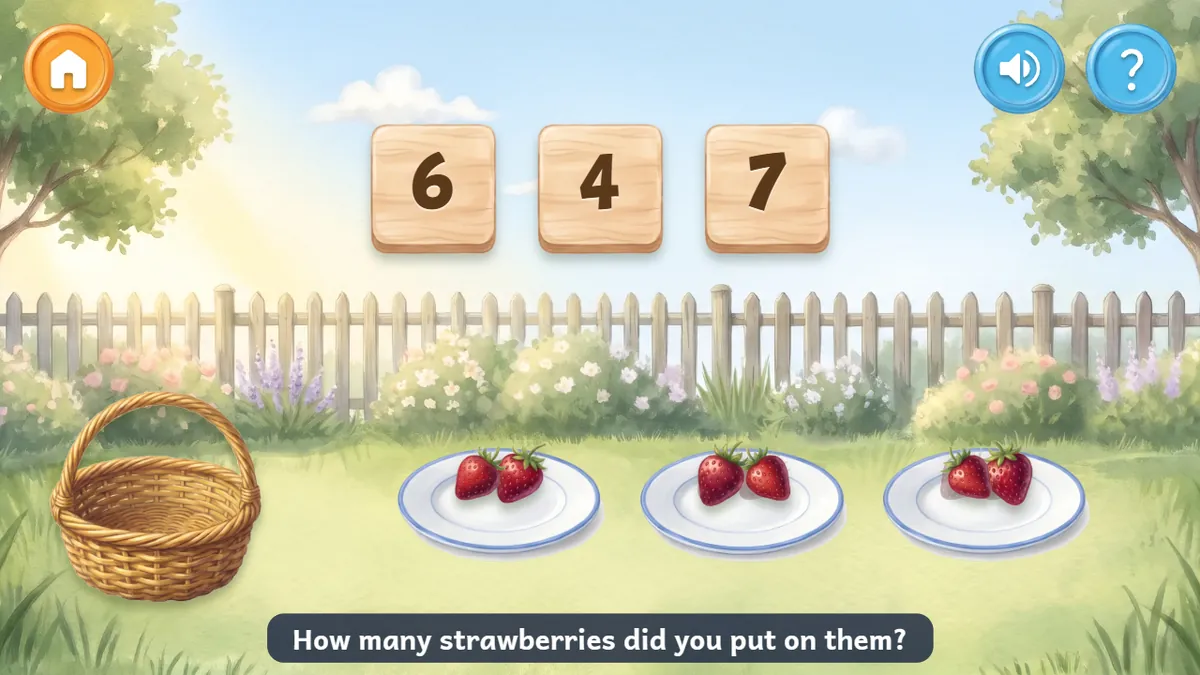
Keep the plates in front of your child as you write the multiplication sentence. Point to each group and talk about what the numbers mean.
Multiplication with equal groups finds the total when every group has the same number.
What your child does in the game
Your child puts the same number of strawberries on every plate. There are 2 to 4 plates, with 2 to 5 strawberries on each, giving totals up to 20. The voice counts the plates in steps, such as "two, four, six", and your child taps the total. Try plates with two on each
How do I explain multiplication to a 5, 6 or 7 year old?
Show your child equal groups, then name how many groups there are and how many objects are in each.
Put two blocks on each of three plates. Point to the plates: "Three groups." Point to the blocks on one plate: "Two in each." Count the whole collection. Then write 3 x 2 = 6 beside it. In the game, 3x2 always means three plates with two on each.
Try two plates of three next. Both totals are six, but the plates show different stories. Common Core 3.OA.B.5 includes swapping the numbers you multiply and getting the same total. Ask your child to build each arrangement and tell you what they see.
What are equal groups?
Equal groups have the same number of items, even if the items look different.
Make plates with two, two and three blocks. Ask, "Does every plate have two?" Count each plate separately, then move the extra block aside. "Three groups" tells us how many groups there are. It does not tell us whether they are equal.
Is multiplication repeated addition?
For whole-number equal groups, you can add the same amount again and again: three groups of two is 2 + 2 + 2.
The number you add each time is the amount on each plate. There are three twos, so the total is six. Writing 3 + 2 would join just two amounts, a different picture. Use repeated addition to explain these groups; later kinds of multiplication need other explanations too.
What is an array?
An array is a set of objects in rows and columns. Common Core 2.OA.C.4 includes this model.
Slide your six blocks into three rows of two. Keep the rows straight and leave small gaps between them. Count two in each row, then count the total. The garden game uses plates rather than an array-building scene.
Common mistakes and what to do
Look at what your child counted, then use the matching row below to show the question again.
| What you see | What it means | What to try |
|---|---|---|
| Three plates hold two, two and three | There are three groups, but they are unequal | Count each plate; move the extra block aside, then check every plate again |
| Your child answers five for three groups of two | Five matches 3 + 2, a different arrangement | Point to each whole plate while saying "two, two, two"; count all six |
| Your child answers three | Three names the plates, not the total blocks | Ask "How many plates?" and "How many blocks altogether?" separately |
| Your child counts every block instead of counting in twos | The method counts individual items | Allow that count; afterwards circle each pair and say the running totals together |
| Your child makes two plates of three for 3x2 | The total matches, but the pictured story differs | Read "three plates, two on each"; rebuild it, then compare the two arrangements |
Try it without a screen in 2 minutes
You only need three plates and six blocks.
- Put the empty plates in a row. Say, "Three plates."
- Place two blocks on each. Say, "Two on every plate."
- Ask your child to check each plate, then count all the blocks.
- Point to each pair and say, "Two, four, six." Finish with "Six altogether."
Practise in the game
Groups of two uses two, three and four plates with two on each.
Groups of three uses two, three and four plates with three on each.
Groups of five uses two, three and four plates with five on each. These are small equal-group sets, not complete times tables.
What schools expect
Schools introduce formal multiplication in different years. Use these references to talk with your child's teacher about what to try at home; our dated teaching order puts them side by side.
| US Common Core (2010) | England national curriculum (2013) and DfE guidance (2020) |
|---|---|
| 2.OA.C.4 uses arrays as groundwork. Grade 3 3.OA.A.1 begins "Interpret products of whole numbers". | Year 1 multiplication and division includes "using concrete objects, pictorial representations and arrays" in the national curriculum. Year 2 2MD-1 says, "The 3 represents the number of groups." |
For approximate ages, England Year 1 is 5 to 6 and Year 2 is 6 to 7; US Grade 3 is usually 8 to 9. Entry dates vary. Ask the teacher which model and notation the class uses.
Sources
- DfE Mathematics guidance: Year 2 (2020), 2MD-1, pages 30 to 31.
- Common Core Grade 2 operations (2010), 2.OA.C.4.
- Common Core Grade 3 operations (2010), 3.OA.A.1 and B.5.
- England mathematics programmes of study (2013), Years 1 and 2.
Questions parents ask
What age do kids learn multiplication?
England introduces problems with objects in Year 1, usually ages 5 to 6; Common Core Grade 3, usually ages 8 to 9, formally covers what products mean. You can try a small equal-group story at home without waiting for that school year. Ask your child's teacher what to try next.
Can a 6 year old learn multiplication?
Try making equal groups at six without asking your child to memorise tables. England's Year 1 curriculum includes multiplication problems with objects. Put two blocks on each of three plates, name the groups and count the total together. Leave the plates and blocks out while you talk.
Is multiplication repeated addition?
For the whole-number groups here, repeated addition describes the same collection: three plates of two make 2 + 2 + 2. DfE 2MD-1 links those expressions to multiplication. Show the plates beside the writing so each two has a visible group, then count the six items together.
Should I teach multiplication and division together?
You can connect a small pair of stories while naming each action. Make three groups of two, then share the same six objects onto three plates. Common Core 3.OA.B.6 links division with an unknown multiplication factor. Our sharing guide explains the second story and the game's meaning of division.